
Life in the UK Test & British Citizenship: The Complete Guide

A practical guide to settling in the UK and becoming a British citizen: the real adjustment, the routes and eligibility, the Life in the UK Test itself, and how to prepare — including for free, in 11 languages.
What does life in the UK actually feel like?
Adjusting to the UK happens in stages. Feeling unsettled at first is normal.
Most people go through the same rough arc: an exciting first few weeks, then a harder stretch once the newness wears off, then a slow climb back up, then — eventually — it just feels like home.
A few things catch almost everyone off guard.
The weather. Short winter days and rain with no warning. A real adjustment, not small talk.
Loneliness. Being away from family hits harder than expected, especially if you've never lived alone before.
London isn't the whole story. A one-bed flat can run £1,800 a month in central London. In Manchester or Nottingham, under £1,000 is common — and both have strong Bangladeshi, Pakistani, Indian, Somali and Polish communities already.
Social habits differ. Proper queueing. Reflexive apologies. Quieter small talk. More personal space.
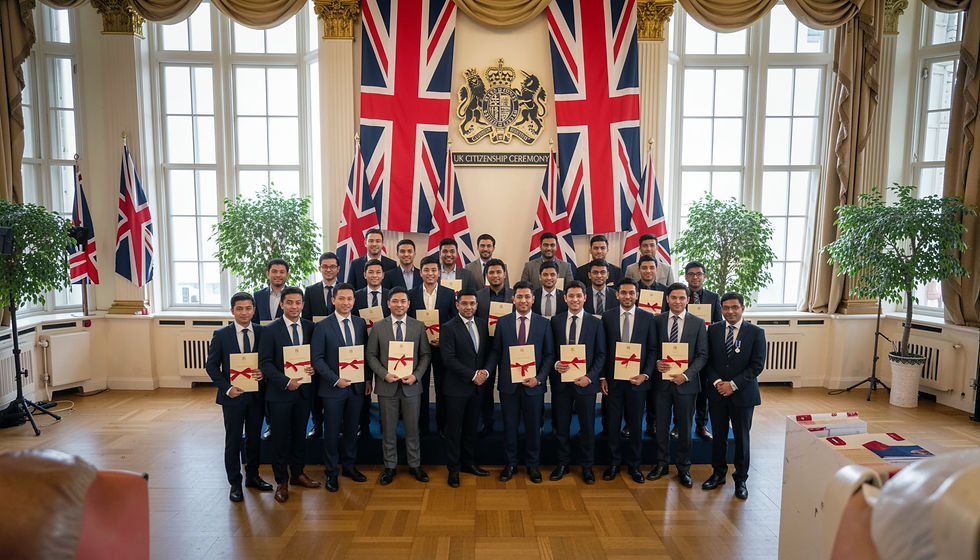
The "temporary" feeling drags. Years on a visa waiting for the next status update can feel uncertain. That's exactly why Indefinite Leave to Remain — and later, citizenship — means so much. Citizenship day has an actual ceremony: an oath, a pledge, a certificate, a welcome pack. A real moment, not an envelope in the post.
If you're in the hard middle stretch right now, that's normal. It's part of the process.

Image: wide shot of a young Bangladeshi family walking through a UK city street
Your path to British citizenship: routes and eligibility
The general pipeline looks like this:
Visa → live in the UK for a qualifying period → Indefinite Leave to Remain (ILR) → hold ILR for 12 months → apply for citizenship (naturalisation) → citizenship ceremony
Getting to ILR (settlement)
ILR gives you the right to live, work and study in the UK with no time limit. It's usually the step right before citizenship. How long it takes depends on your route:
Work visas (Skilled Worker, T2, etc.): usually 5 years. Tier 1 can be 2–3 years. Innovator Founder or Global Talent can be 3 years.
Family route: if your partner, parent or child is British or holds ILR.
Long residence: 10 years of continuous lawful residence, any visa type.
UK Ancestry visa: 5 years.
BNO visa: 5 years.
Separate routes also exist for refugees, humanitarian protection, returning residents, armed forces, and stateless people.
Applying for citizenship (naturalisation)
Once you have ILR, the standard route needs:
5 years living in the UK
ILR, settled status, or indefinite leave to enter held for 12 months (skipped if married to a British citizen)
Age 18+
Proof of English
A pass on the Life in the UK Test
Good character
Intent to keep living in the UK
Absences matter too: no more than 450 days away in the 5-year period, and no more than 90 in the final 12 months.
Cost: £1,839 total — £1,709 for the application, £130 for the ceremony. Decisions usually land within 6 months.
Other ways to qualify
Married to a British citizen: eligible after 3 years' residence plus ILR, no extra wait
Irish citizens: after 5 years
EU Settlement Scheme: settled status → 12 months; pre-settled → 5 years plus one more
Born in the UK, has a British parent, holds another British nationality, is stateless, or is a Commonwealth citizen (or their parent) who arrived before 1973 under the Windrush Scheme
A heads-up about upcoming changes
The government wants to raise the standard settlement wait from 5 years to 10, with shorter routes for some groups and longer ones for others. Nothing's changed yet — the 5-year rule still applies — but it's under active consultation. Check gov.uk before relying on any timeline here.\

Image: eye-level view of a young Indian man holding UK visa documents
What is the Life in the UK Test?
Before prepping, it helps to know exactly what you're prepping for.
The test is required for most citizenship and settlement applications. It checks your knowledge of British history, values and everyday life. It's based on one source only: Life in the United Kingdom: A Guide for New Residents.
Format
24 multiple-choice questions
45 minutes
Computer-based, at one of 30+ test centres
75% to pass — 18 out of 24
£50, booked online at least 3 days ahead
Fail and you can rebook — but you pay £50 again
Pass and you get a unique reference number for your application
What's actually tested
The values and principles of the UK
What is the UK?
A long and illustrious history
A modern, thriving society
The UK government, the law, and your role
You don't need to take it if you
Are under 18 or 65+
Already passed it (you don't retake for citizenship)
Have a long-term physical or mental condition, backed by an exemption form or doctor's letter

Image: close-up of a Pakistani man studying for the Life in the UK test
How to prepare for the Life in the UK Test
The handbook alone isn't enough for most people. It's easy to feel ready without being ready.
Take a free mock test first. See where you stand.
Review every wrong answer properly — understand why, not just that.
Focus revision on your weak topics, not the easy ones.
Practise under real timing. 45 minutes, no pausing.
Repeat until the same topics stop tripping you up.
Official resources
Book your test: gov.uk/life-in-the-uk-test
Buy the handbook: officiallifeintheuk.co.uk/shop
Check eligibility: gov.uk/british-citizenship
Free tools on Free Life in UK
17 free mock tests — the real 24-question, 45-minute format
120 practice questions — a bigger bank to expose weak spots
Mock tests with audio — revise on the commute
AI Tutor — explains why an answer is right or wrong, not just the score
Self-study not working? Online and in-class training gives you more structure.

Practise in your own language
One thing to know upfront: the real exam is English-only. But understanding the material doesn't have to start in English.
Free Life in UK runs mock tests in 11 languages, so you can learn the content first, then move to English once it's clear:
Each language: 17 mock tests, unlimited attempts, instant results, AI Tutor explanations. Browse the full hub.

Beyond the test: what else you'll need
The Life in the UK Test is one piece. Here's what else tends to come up.
B1 English (Speaking & Listening). Separate from the Life in the UK test. Needed for ILR and citizenship unless exempt. Prove it with a B1+ qualification or a degree taught in English. Four Home Office-approved tests cover it: Trinity GESE Grade 5, IELTS Life Skills B1, LanguageCert ESOL SELT B1, and Pearson PTE Home B1. See B1 prep options.
Driving Theory Test. Often the next practical step. DVSA-style mocks and hazard perception are available in Arabic, Bangla, Pashto, Somali, Tamil and Urdu.
IELTS. Useful for work, study or immigration more broadly. Structured 4-skills prep here.
Visa and immigration support. Guidance on Student, Skilled Worker, Spouse & Family, and Standard Visitor visas, plus ILR, citizenship, and passports. See immigration and visa support.
Good character. Part of naturalisation. The Home Office checks your criminal record, immigration history, and financial conduct. Worth knowing early, not at application stage.
The full cost. Visa fees, the immigration health surcharge, ILR fees, the Life in the UK test (£50), an English test fee, and citizenship (£1,839 including the ceremony). Budget for the whole path, not just the next step.
The citizenship ceremony. The real final step. You get an invitation once approved and must attend within 3 months. An oath or affirmation, a pledge, usually 2 guests, and you leave with your certificate.
Quick answers
Do I retake the Life in the UK test for citizenship if I already passed it for ILR? No. Once you've passed, you don't take it again.
What if I'm under 18 or 65+? You're exempt entirely.
Do dependants wait 12 months after ILR before applying for citizenship? Not if they're married to a British citizen. They can apply right away.
________________________________________________________
Ready to see where you stand? Try a free mock test, or practise in your own language first if that's easier.


Comments